The Idea of Communism 3 by Alex Taek-Gwang Lee & Slavoj Žižek
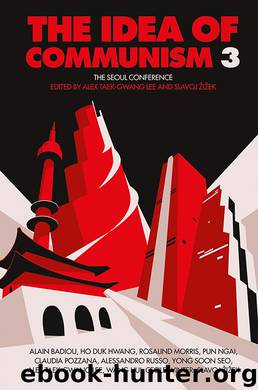
Author:Alex Taek-Gwang Lee & Slavoj Žižek
Language: eng
Format: epub
Publisher: Verso Books
8Manifestos without Words: The Idea of Communism
in South Korea – The Case of the Gwangju May
Yong Soon Seo
The Gwangju May and South Korea in the 1980s: The Event and Its Aftermath
In what follows I will examine the political event that took place at Gwangju in May 1980, named officially by the Korean government in 1996 the Gwangju Democratization Movement.1 This event constitutes a decisive moment in the contemporary history of South Korea. At the same time, the event is very complex. It served to determine the course of Korean social movements during the 1980s, as well as the macro-political process of democratization. Moreover, when viewed from outside the frame of democracy (due of course to its status as a popular uprising), an entirely different question emerges: the idea of communism. My main focus regarding the Gwangju event resides in this problematic idea. In order to understand it, I shall first of all summarize the event itself.
The protest and revolt of Gwangju began with a demonstration on the morning of 18 May 1980 against, and in defiance of, the martial law proclaimed by General Chun Doo-Hwan and his political supporters, who had taken control of the state by means of a military coup in the preceding months. The demand of the people of Gwangju was very simple: to establish a democratic regime. Obviously, there was nothing revolutionary about it.
The response was ruthless state violence, which was exceptional at the time in its severity and scope. Under martial law, airborne troops were called in to quash demonstrations by unarmed citizens with deadly force. This violent reaction enraged the people of Gwangju, who overcame their fear and rose up in revolt. The participants in the protests were ordinary citizens, and their demands were modest and not exceptional: liberal democracy, political reform and the end of martial law. But what they received instead was extreme violence; ineffable violence beyond words; violence unprecedented in peacetime in the modern history of Korea. In the end, with fear dispelled, almost every citizen stood up to the army’s repression. The military forces opened fire at protesting crowds, causing large numbers of casualties. These ordinary people raided the armouries and police stations in nearby towns, and, armed with guns and grenades, spontaneously defended themselves. After intense gunfights lasting until the night of 21 May, the improvised civilian militia corps succeeded in pushing the army out of the city, thus transforming it into a temporarily liberated space. A great majority of those who joined the civilian militias were from the lower classes. Although intending to continue their resistance to the point of victory, the ‘resolution committee’, composed of prominent local figures – such as religious leaders, lawyers and professors – tried to calm down and normalize the situation in order to save civilian lives, and negotiate terms with the army for the people’s safety once they had disarmed. But the army already had a plan to quell the resistance ruthlessly, which led to its prolongation, with civilians prepared to risk their own safety in the pursuit of their struggle.
Download
This site does not store any files on its server. We only index and link to content provided by other sites. Please contact the content providers to delete copyright contents if any and email us, we'll remove relevant links or contents immediately.
| Anarchism | Communism & Socialism |
| Conservatism & Liberalism | Democracy |
| Fascism | Libertarianism |
| Nationalism | Radicalism |
| Utopian |
The Secret History by Donna Tartt(19016)
The Social Justice Warrior Handbook by Lisa De Pasquale(12179)
Thirteen Reasons Why by Jay Asher(8879)
This Is How You Lose Her by Junot Diaz(6867)
Weapons of Math Destruction by Cathy O'Neil(6257)
Zero to One by Peter Thiel(5778)
Beartown by Fredrik Backman(5726)
The Myth of the Strong Leader by Archie Brown(5489)
The Fire Next Time by James Baldwin(5421)
How Democracies Die by Steven Levitsky & Daniel Ziblatt(5207)
Promise Me, Dad by Joe Biden(5138)
Stone's Rules by Roger Stone(5073)
A Higher Loyalty: Truth, Lies, and Leadership by James Comey(4944)
100 Deadly Skills by Clint Emerson(4908)
Rise and Kill First by Ronen Bergman(4766)
Secrecy World by Jake Bernstein(4735)
The David Icke Guide to the Global Conspiracy (and how to end it) by David Icke(4694)
The Farm by Tom Rob Smith(4498)
The Doomsday Machine by Daniel Ellsberg(4477)
